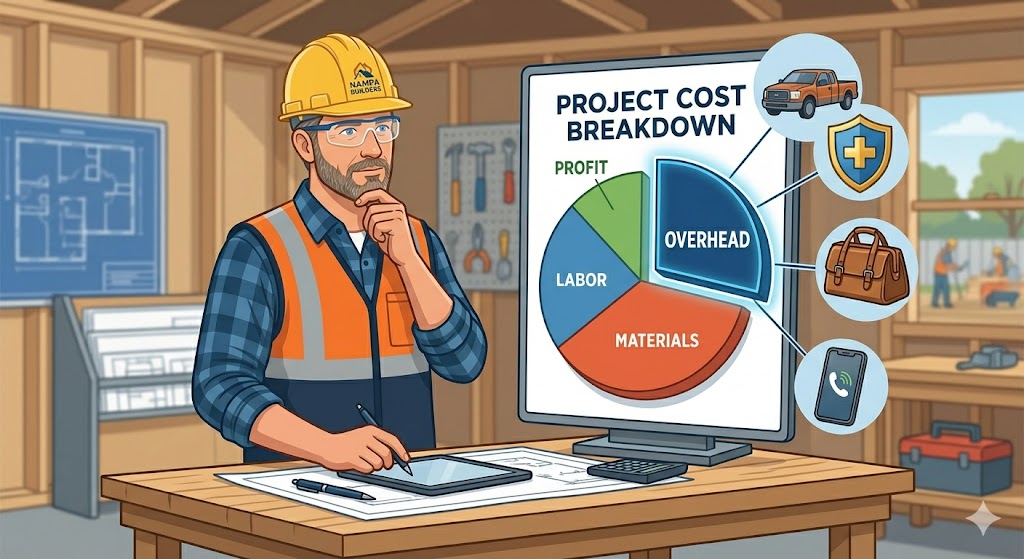
What is a good overhead percentage for a contractor? Published benchmarks imply overhead of roughly 15% to 19% of direct job cost for builders and specialty trade contractors (our arithmetic from CFMA 2026 and NAHB gross and net margins), and about 34% for remodelers, whose operating expenses also include indirect construction costs. A good number is the one you calculate from your own expenses, not a figure you copy from a forum. Run the actual math so you are not guessing.
Ask ten contractors what they use and you will get ten different answers, mostly guesses. This article keeps the same walkthrough: what overhead is, rough ranges by trade, how to calculate your real rate, and how to apply it to every job.
What Counts as Contractor Overhead?
Overhead is every business cost that is not a direct job cost. Direct job costs are labor (your time and any employees' time working on the job) and materials (what you bought specifically for that job). Everything else is overhead.
For most trade contractors, overhead includes:
- Vehicle expenses — loan or lease payments, insurance, registration, oil changes, tires, repairs, and depreciation
- Tools and equipment — purchase costs, replacement costs, repairs, and depreciation on tools you own
- General liability insurance — required for nearly every commercial and many residential jobs
- If you only need coverage for a single job rather than a year-long binder, Thimble sells general liability by the job or the month, which is easier to put in overhead as a real number instead of a guess.
- Workers' compensation insurance: if you have employees or are required to carry it solo in your state. Leave it out of overhead if it is already in the hourly labor cost you enter in the calculator, so it is not counted twice.
- Business software and subscriptions — estimating software, invoicing tools, scheduling apps, accounting software
- Marketing and advertising — your website, Google ads, yard signs, business cards, Angi or HomeAdvisor leads
- Phone and communications — your business phone line, data plan
- Office and administrative costs — whether a home office or separate space, plus supplies
- Non-billable time — hours spent writing estimates that don't convert, following up on invoices, scheduling, and managing the business
- Training and licensing fees — continuing education, license renewals, trade association dues
- Accounting and legal — bookkeeper, CPA, any business attorney fees
Notice what's not on that list: fuel and drive time charged directly to jobs. If you're tracking job-specific travel costs separately (which you should be), those are direct costs, not overhead.
Published Benchmarks and Example Ranges by Trade
No published survey gives overhead as a percent of direct job cost. The 15% to 19% and 34% figures above are a derivation from published gross and net margins. You can check the arithmetic:
- CFMA's 2026 Financial Benchmarker (FY2025, specialty trade contractors): 22.1% gross, 7.5% net, so (22.1 - 7.5) ÷ 77.9 ≈ 18.7% of direct cost.
- NAHB Cost of Doing Business (builders, FY2023, posted Mar 11, 2025): 20.7% gross, 8.7% net, so 12.0 ÷ 79.3 ≈ 15.1%. The same 20.7% and 8.7% appear in NAHB's July 14, 2025 note. Builders' cost of sales includes land.
- NAHB remodelers (FY2024, posted Apr 8, 2026): 29.9% gross, 6.3% net, so 23.6 ÷ 70.1 ≈ 33.7%. Both NAHB studies count owner pay in operating expenses; the remodeler figure also includes indirect construction costs.
The trade rows below are illustrations with no published source. They are not survey data and they are not benchmarks. Do not copy a row into a bid.
| Trade | Example range (not survey data) | Notes |
|---|---|---|
| Plumber / HVAC | 18–28% | Higher due to specialty tools, service vehicles, licensing costs |
| Electrician | 18–25% | Licensing, specialty meters, permit coordination time |
| Roofer | 15–22% | High equipment cost but simpler material management |
| General Contractor | 10–20% | GC fee typically covers coordination overhead separately |
| Painter | 12–20% | Lower tool overhead, but marketing and non-billable time adds up |
| Landscaper | 15–25% | Equipment-heavy; mowers, trailers, irrigation tools |
| Handyman | 15–22% | High non-billable time ratio; many short jobs with disproportionate admin |
These are ranges, not targets. Your actual rate depends on how you run your business, how much equipment you carry, how many non-billable hours you log, and how efficiently you convert estimates to jobs.
How to Calculate Your Actual Overhead Rate
The right way to find your overhead rate is to calculate it from your own financial records — not to pick a number from a chart. Here's the method:
- Pick a time period. Use the last 3 months or the last full calendar year. Three months is faster; a full year smooths out seasonal variation.
- Add up your total revenue for that period.
- Subtract your direct job costs — all labor costs and all material costs that were billed directly to specific jobs.
- Add up every other business expense for that period. This is your overhead total.
- Divide overhead total by direct job costs. The result, multiplied by 100, is your overhead rate.
Example: Last quarter — Revenue: $85,000. Direct labor: $38,000. Direct materials: $22,000. All other business expenses (vehicle, insurance, tools, software, marketing, etc.): $12,500.
Overhead rate = $12,500 ÷ ($38,000 + $22,000) = $12,500 ÷ $60,000 = 20.8%
This means for every dollar of direct job cost, you're spending about 21 cents on overhead. That 21 cents needs to be in your price on every single job.
Why Contractors Underestimate Overhead
When contractors estimate their overhead rate before calculating it, they often guess low. Here's why:
- Invisible costs don't feel like job costs. The monthly insurance payment doesn't feel connected to the job you're quoting on Tuesday. But it is — it's a real cost of being in business.
- Non-billable time is forgotten. The two hours spent writing an estimate that didn't convert, the afternoon spent chasing an unpaid invoice, the hour on the phone with a supplier — none of this shows up in your job cost records, but it's all real overhead.
- Tools and equipment are amortized. You paid $4,000 for a diagnostic tool two years ago. You're not spending money on it now, so it feels free. But it's depreciating and will need to be replaced — that cost belongs in your overhead rate.
- Mixed personal and business expenses. If your work vehicle is also your personal vehicle, it's easy to undercount vehicle overhead. Same with your phone.
How to Apply Overhead to Your Bids
Once you know your overhead rate, applying it is straightforward. Add it as a percentage of your direct costs (labor + drive labor + materials) on every job. Fuel is added after overhead and is not part of the base.
Example: Job with $500 in direct labor and $800 in materials = $1,300 direct cost. At 20% overhead: $1,300 × 0.20 = $260 overhead. Your cost basis before profit is $1,560. Income and self-employment taxes are owed on your profit, so they do not go in the cost basis.
The JobProfitCalc calculator has a dedicated Overhead % field where you enter your overhead percentage of direct job costs, and it calculates the dollar amount automatically as part of your complete job price. You can update it any time your costs change.
Review your overhead rate every 6 months. Insurance premiums, fuel costs, software subscriptions, and tool replacement needs all change over time. An overhead rate that was accurate in January may be off by July, and that gap silently erodes your margin on every job you price.