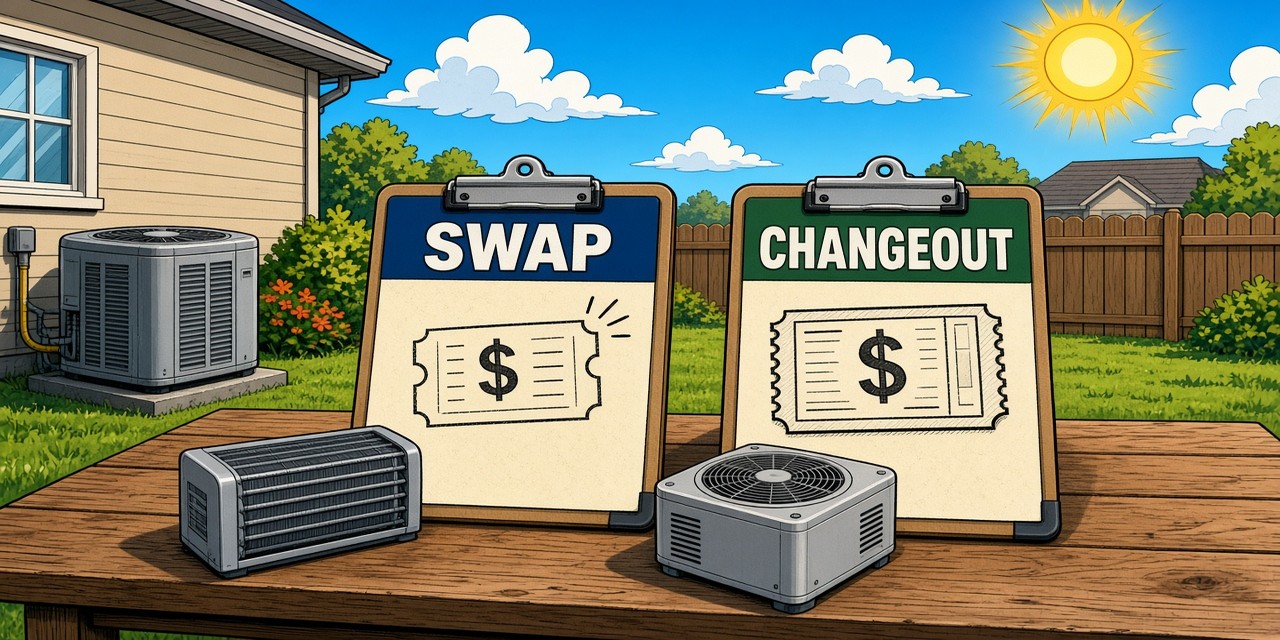
Price both paths on the same customer and the same target margin: a single-component swap when like-for-like servicing is allowed, and a matched condenser-plus-indoor changeout when you are installing a new system. Classify the job from the failed side, the data plate, and whether you are replacing one specified component or both, then load hours, materials, refrigerant, and tax into separate calculator runs so you can compare net profit and effective dollars per hour before anyone sees a quote.
The costly mistake is presenting one option—a forced full changeout, or a bare condenser with no second ticket—without building both stacks. Fall is when that fork shows up on real calls: FR Doc. 2026-10387 (91 FR 31284), published May 26, 2026 and effective July 27, 2026, removed the hard install deadline for residential and light commercial AC/HP systems when every specified component was manufactured or imported before January 1, 2025, so this is the first heating season under that amended inventory path at 40 CFR 84.54. HARDI reported on November 19, 2025 that A2L equipment was about 91% of distributor unitary sales in September 2025. ACCA’s May 22, 2026 note tied the lift of the deadline to refrigerant economics you still have to price as your own line. Energy.gov’s fall furnace-check guidance clusters seasonal maintenance traffic, and Allied Air’s June 16, 2026 manufacturer note restated the field rule of thumb: one component can be a repair; replacing both sides is treated as a system, with pre-2025 inventory installable while supplies last. None of those signals invent a national A2L equipment premium—leave that blank and use your invoice.
Why the Fork Matters for the Quote
A failed outdoor unit on an existing R-410A split is not automatically a “must change out everything” sales script, and it is not automatically a “drop in any condenser” parts ticket. The regulatory path and the cost stack move together. When you treat a condenser-plus-coil install as a new system, you are usually on the A2L / GWP under 700 equipment path unless every specified component is verified pre-2025 manufacture or import inventory. When you replace one side only for servicing an existing system, you may still be in like-for-like territory when labels, manufacturer match rules, and your authority having jurisdiction (AHJ) allow it. Section F of FR Doc. 2026-10387 did not ban single-component R-410A repair parts and did not change EPA’s treatment of replacement condensing units used to service existing systems.
State and local rules can be stricter than the federal baseline—New York is the usual example people raise—so check the AHJ before you federalize the answer on the customer’s porch. This post is educational, not legal advice. Verify date codes, “for servicing existing equipment” labels, and manufacturer matching yourself, and read the current Federal Register and eCFR text rather than an old FAQ that still frames a blanket install cutoff.
Classify the Job Before You Open the Calculator
Walk the equipment first. The quote is only as honest as the classification.
- Name what failed. Outdoor condensing unit, indoor coil or air handler, compressor-only inside the outdoor cabinet, or both sides. Write that on the ticket before you price anything. A compressor job inside an existing outdoor shell is not the same scope as swapping the outdoor unit, and neither is the same as pairing a new outdoor with a new indoor.
- Read the existing data plates. Refrigerant type, tonnage, model and serial, and any match or AHRI pairing notes come from the plates on the equipment in front of you. Photograph them. If a plate is missing or unreadable, stop guessing from memory—pull the manufacturer lookup or treat the job as needing a matched changeout until you can verify.
- Read the candidate replacement labels and date codes. Manufacture or import date, refrigerant designation, and any “servicing existing equipment” language live on the carton and unit labels your distributor sends. For a pre-2025 inventory path on a new-system install, you need every specified component of that system manufactured or imported before January 1, 2025, per the amended text at 40 CFR 84.54(c)(1). If you cannot document that, do not sell that path as compliant inventory.
- Decide one component vs both — including both sides over time. One failed side, like-for-like replacement that your manufacturer and AHJ allow → price as a component swap / service path. Condenser and indoor coil together as a new matched system → price as a changeout on the A2L (or other compliant low-GWP) path, unless the full set is verified qualifying pre-2025 inventory. Allied Air’s June 16, 2026 summary matches that field split: one component can be OK for repair; both sides means you are in system territory. Do not treat staging as a workaround. EPA’s preamble at 91 FR 31319 (FR Doc. 2026-10387) states that replacing all components over time constitutes installation of a new system: swapping the outdoor now without the indoor coil is not a new system under that approach, but replacing the indoor coil later is, and the reverse order is treated the same way. Price that later visit as a changeout / A2L path (or verified pre-2025 inventory), not as forever like-for-like service.
- Check the AHJ and match rules before you lock the path. Local code, permit, and manufacturer warranty match requirements can kill a “legal under federal text” swap. If the AHJ is stricter, price the path the AHJ will pass—not the path that sounded cheapest on the phone.
- Only then open two calculator drafts. Same customer, same target job margin, different hours and material stacks. The regulatory fork is a cost-stack fork.
Stale framing to drop: a universal R-410A installation cutoff tied to New Year's Day 2026 for every system, or a claim that every new split must be GWP under 700 with no inventory exception. The reconsideration rule at FR Doc. 2026-10387 / 91 FR 31284 removed the install deadline for qualifying pre-2025 specified-component inventory and left single-component servicing treatment in place. Cite the FR and 40 CFR 84.54, then verify labels on the job.
Build the Swap Ticket and the Changeout Ticket Side by Side
Use the same target margin on both paths. If you want 25% of the selling price, you are setting margin—not typing 25% into a material markup box and calling it done. Keep material markup and job margin separate the way markup vs margin walks on one ticket. Enter each path in the job profit calculator as its own run.
Numbered build for both paths
- Lock the margin target and the tax percentages first. Desired profit margin is the same field on both runs. SE tax % and state tax % (the calculator applies them to your cost subtotal) stay the same percentages too. What changes is the material-heavy changeout’s larger cost base, so the tax dollars move even when the rate does not.
- Set labor hours and workers from the scope, not from a single habit number. Swap path: hours and crew for recovering the old charge, swapping the one component, reconnecting, evacuating, and charging. Changeout path: hours and crew for outdoor and indoor, line-set decisions, possible pad or disconnect work, recovery, and startup. Pull planned hours from your time records on similar scopes; if you have no similar job, write a high and low hour range and run both, then pick the quote that still hits margin at the high end. Loaded labor cost—not the wage alone—belongs in the hourly labor rate field. If you still quote off wage, fix that with your burdened labor rate before you compare paths.
- Enter materials as one part vs a matched set. Swap: the replacement condenser or coil at your invoice cost, plus the small parts that actually ride that ticket (driers, fittings, pad bolts—only what this job uses). Changeout: outdoor and indoor as a matched set at invoice cost, plus line set, pad, disconnect, drain, and other install materials. Material cost is what you paid. Material markup is its own field—do not confuse it with job margin. For refrigerant markup method and broader install pricing structure, use HVAC job pricing; this post does not restate that section.
- Put refrigerant on its own line inside materials (or as its own material entry you can see). Swap path often reuses the legacy refrigerant type for a like-for-like service charge after recovery. Changeout path usually means a different refrigerant family when you are on new A2L equipment. Either way, use the pounds from the data plate or weighed recovery and your current cylinder invoice—never a memorized “per pound” from two seasons ago. Leave any equipment price gap between legacy and A2L blank in this method; type the numbers from the distributor invoice for the exact SKUs you will order.
- Add overhead and drive only when they are real for that path. If both quotes are the same trip pattern, keep drive and overhead allocation consistent so you are not padding one path. If the changeout needs a second trip for crane, attic coil, or inspection that the swap does not, put that second trip’s drive/fuel and any extra overhead only on the changeout run.
- Read suggested charge, net profit, margin, and effective $/hr on both runs before you talk options. Presenting only the changeout (or only the condenser) hides whether the “cheaper” path actually pays your hour. The customer can still choose; you should know the margin on both choices.
Worked Example: Same Customer, Two Tickets
These are made-up round numbers chosen so the arithmetic is easy to follow. They are not market prices, typical jobs, or a claim about what A2L equipment “usually” costs above R-410A. For A2L outdoor and indoor pricing, use your invoice; the example leaves that premium unstated on purpose.
Assume a residential straight-cool split where the outdoor unit failed, the indoor coil is still serviceable on paper, and you are offering (A) a like-for-like outdoor swap when labels and AHJ allow it, and (B) a matched outdoor-plus-indoor changeout on compliant new-system equipment. Target job margin: 25% of selling price on both. One tech on the swap; two workers on the changeout. Tax percentages identical on both runs.
Run Path A and Path B separately. On Path A, labor is lighter and materials are one major piece plus recharge. On Path B, labor expands with crew and hours, materials jump because you are selling a matched set, and the same tax percentage sits on a larger cost subtotal—so tax dollars rise even though you did not change the rate fields. Compare suggested customer charge, net profit, the margin the calculator shows (profit ÷ price), and effective $/hr. If Path A shows a thin effective hourly rate after recovery and vacuum time, you will see it before you discount. If Path B’s price looks high only because you forgot material markup or loaded labor, you will see that too.
That is the same relationship as the markup-vs-margin walkthrough: a 25% margin needs enough price that 25% of the selling price remains after cost. Do not “split the difference” between the two suggested charges and call it pricing. Adjust hours, invoice costs, or markup fields that are wrong; keep the margin target honest on both.
Sanity Checks and Common Mistakes
- Quoting only the changeout “because A2L.” Classify first. If a single-component service path is allowed, build that ticket anyway so the customer sees a real comparison and you know what each path pays.
- Quoting a bare condenser with no matched-system ticket when both sides must change. If the coil is wrong for the outdoor, the warranty will not save the margin. Price the matched path you will actually install.
- Selling pre-2025 inventory without date codes. The amended 84.54(c)(1) path needs all specified components manufactured or imported before January 1, 2025. No plate, no path—order verified stock or move to compliant new-system equipment.
- Mismatched tonnage to “make the old coil work.” That is a comfort and warranty problem waiting to become a callback. Match to manufacturer rules, not to the cheapest outdoor on the truck.
- Absorbing refrigerant, recovery, or disposal into labor. Keep refrigerant visible. Recovery and haul-off are job costs; if they happen, they belong on the ticket that uses them.
- Padding drive on the swap to close the price gap with the changeout. Only charge the second trip when there is a second trip. Crooked overhead makes both paths untrustworthy when you review jobs later.
- Treating material markup as job margin. Markup on the condenser is not 25% of the selling price. Fix the labels with the markup vs margin method, then re-run both paths.
- Ignoring AHJ stricter rules. Federal text is not a local permit. If the inspector will not pass the swap, the profitable ticket was fiction.
- Leaving A2L tooling, leak detection, or training off the changeout path when they are real incremental costs. Put them in overhead or as materials/tooling recovery the way your books already treat them—do not scare the customer with vibes, and do not eat them silently.
When a figure is missing: no invoice yet → call the distributor and hold the quote, or quote a not-to-exceed with the invoice placeholder called out. No hour history → use a written high/low and protect margin at the high. No date code → do not claim the pre-2025 inventory exception. No AHJ answer → do not promise the swap path in writing.
Short FAQ
Is replacing only the outdoor unit always legal under federal rules?
Not “always”—it depends on whether you are servicing an existing system with a specified-component replacement versus installing a new system, plus manufacturer match rules and your AHJ. FR Doc. 2026-10387 Section F did not ban single-component R-410A repair parts and did not change treatment of replacement condensing units for servicing existing systems. Verify labels and local requirements; this is not legal advice.
When does condenser plus indoor coil become a new-system install?
When you are field-assembling a new matched system from those components, treat it as installing a new residential or light commercial AC/HP system under 40 CFR 84.54(c)(1): GWP under 700 path, unless every specified component is manufactured or imported before January 1, 2025 and you can document that inventory path. Replacing both sides is the system fork Allied Air restated on June 16, 2026—price it that way. Doing the sides in sequence does not keep you on the service path forever: 91 FR 31319 (FR Doc. 2026-10387) treats the later replacement of the other side as a new-system install, order does not matter. Price that later visit as changeout / A2L (or verified pre-2025 inventory).
The Bottom Line
Classify the failure, read the plates and date codes, check the AHJ, then build a swap ticket and a changeout ticket on the same margin before you present a path. Put hours, matched materials, refrigerant, and only the drive you will actually run into the job profit calculator, and keep broader service-call, flat-rate, and refrigerant markup method on how to price HVAC jobs instead of reinventing it here. The first heating season under the July 27, 2026 effective date is exactly when guessing one path costs you either the job or the margin.
Educational estimates only — not legal, tax, or engineering advice. Verify current EPA text (FR Doc. 2026-10387 / 91 FR 31284 and 40 CFR 84.54), equipment labels, manufacturer match rules, and your AHJ. Consult licensed HVAC, legal, and tax professionals for your situation.