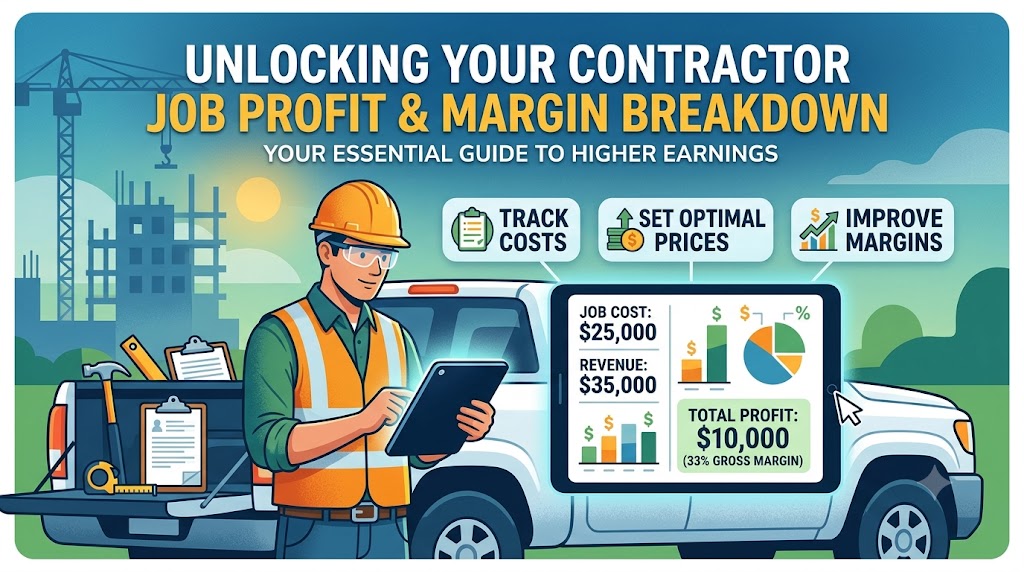
A contractor who grossed $400,000 last year is not necessarily doing better than one who grossed $200,000. Revenue tells you how busy you were. Profit margin tells you how well you ran the business.
The number that actually matters — the one that determines whether your business is building toward something or just spinning its wheels — is what percentage of every dollar of revenue you actually keep after paying for labor, materials, overhead, and taxes.
For most trade contractors, that number is lower than it should be. Not because the market won't support better margins, but because most contractors never sit down and calculate what they're actually keeping — or compare it to what healthy trade businesses look like.
This post covers what healthy contractor profit margins look like by trade in 2026, why margins vary between industries and job types, what the warning signs of thin margins are, and how to close the gap between where you are and where you should be.
Gross Margin vs. Net Margin — Know the Difference
Before getting to the benchmarks, this distinction has to be clear because the two numbers are completely different — and confusing them leads to very wrong conclusions about how well your business is actually performing.
Gross profit margin measures what's left after subtracting direct job costs — primarily labor and materials — from your revenue. It does not account for overhead: your truck payment, insurance, licensing, accounting, software, or any other cost that exists whether or not a specific job is running.
Net profit margin measures what's left after subtracting every cost of running the business — direct job costs plus all overhead expenses. This is the real number. It represents actual profit: money that belongs to you after the business is fully paid.
A roofing contractor with a 35% gross margin sounds healthy. But if overhead — trucks, insurance, employees, yard space, equipment — consumes 20 percentage points of that, the net margin is 15%. That's fine. If overhead is eating 28 points, net margin is 7%. That's a problem that will eventually become a crisis.
The margin numbers in this post are net margins — what you keep after everything. That is the number worth tracking, benchmarking, and optimizing.
Contractor Profit Margin Benchmarks by Trade in 2026
These ranges reflect typical net profit margins for well-run trade businesses in 2026. "Well-run" means the contractor is pricing correctly, tracking job costs, controlling overhead, and not chronically underpricing to stay busy.
The ranges are wide because margins vary significantly between service/repair work (higher) and new construction or large-scale replacement projects (lower but higher volume).
| Trade | Service / Repair Work | New Construction / Replacement |
|---|---|---|
| HVAC | 18% – 28% | 12% – 20% |
| Plumbing | 18% – 25% | 12% – 18% |
| Electrical | 15% – 25% | 10% – 18% |
| Roofing | 18% – 28% (repairs) | 10% – 20% (replacements) |
| General Contractor | 15% – 22% (remodels) | 8% – 15% (new builds) |
| Painting | 18% – 28% | 15% – 22% |
| Flooring Installation | 18% – 28% | 15% – 22% |
| Carpentry / Millwork | 20% – 30% | 14% – 22% |
| Drywall | 12% – 20% | 10% – 16% |
| Landscaping | 15% – 25% | 12% – 20% |
| Concrete / Masonry | 12% – 22% | 10% – 18% |
| Handyman | 15% – 25% | N/A |
How to read this table: If your current net margin on service work is consistently below the low end of your trade's range, you are likely underpricing, over-spending on overhead, or both. If you're at or above the high end, you're running a tight ship — protect it by not chasing volume at the expense of margin.
Why Service Work Carries Higher Margins Than New Construction
This pattern shows up in nearly every trade, and the reasons are consistent:
Urgency pricing. A homeowner whose furnace failed at 6 a.m. in January is not comparison shopping. They are calling whoever picks up the phone. Urgency commands premium pricing that new construction bidding does not allow.
Smaller ticket, less price sensitivity. A $350 service call doesn't trigger the same scrutiny as a $35,000 roof replacement. Customers are less likely to get multiple quotes on a $400 plumbing repair than on a $12,000 bathroom remodel.
Diagnostic expertise. Finding and diagnosing a problem is skilled, billable work. Service technicians are paid for knowledge and problem-solving, not just labor. That expertise component supports higher margins than commodity installation work.
Less competition per job. New construction and large replacement projects are formally bid in many markets. Service and repair calls are less likely to involve competitive bidding, which protects margin.
New construction typically features lower margins not because it pays poorly, but because it is competitively bid, material-intensive, weather-dependent, and subject to delays outside your control — all of which compress margin even on well-priced jobs.
What's Happening to Margins in 2026
Margins across most trades are under more pressure in 2026 than they were two or three years ago. Understanding why helps you respond correctly.
Labor costs have increased. Helper and apprentice wages have risen significantly across most U.S. markets. Skilled labor in licensed trades remains in short supply. If you have employees or regularly hire subcontractors, your labor cost per job is higher than it was in 2023. Your pricing needs to reflect that.
Insurance costs continue to climb. General liability premiums for trade contractors have increased steadily. If you haven't repriced your overhead in the last 12–18 months, you may be running on a cost basis from a year when insurance was cheaper.
Material prices have partially stabilized. After the sharp spikes of 2021–2022, material costs in most trades have moderated. However, some categories — copper, wire, HVAC equipment, roofing materials — remain elevated above pre-2020 baselines. Material markup remains essential, not optional.
Competition has returned in most markets. The post-pandemic contractor shortage that allowed many trade businesses to charge premium rates and still have backlogs has eased in most regions. Customers are getting more quotes again. A well-written, professionally presented estimate now matters more than it did when demand was outrunning supply.
The contractors protecting and growing their margins in 2026 are the ones who raised prices to match their actual cost increases — not the ones who absorbed the increases and hoped volume would compensate.
Is 20% Net Profit Realistic for a Solo Contractor?
Yes — and for many trades it should be the floor, not the aspiration.
Twenty percent net margin on service and repair work is achievable for a solo or owner-operated trade business in most markets. Here's why it's not only realistic but rational to target it:
Your risk justifies it. You carry liability for the work. You manage the schedule, the customer relationship, the warranty, and the business. An employee with zero risk earns a wage. You, as the business owner, earn a wage plus a return on the risk you're carrying. That return is your profit margin. Twenty percent is not greed — it's appropriate compensation for ownership risk.
Your overhead demands it. A solo contractor's overhead includes truck, tools, insurance, licensing, software, marketing, and any professional services (accountant, attorney). These costs are real and fixed regardless of how many jobs you run. Margins below 15% frequently mean overhead is not being fully covered, which surfaces as a cash flow problem over time even when revenue looks strong.
The math works. On $150,000 in annual revenue, a 20% net margin is $30,000 in profit before taxes — profit that goes to you after every cost is covered. At 10% margin it's $15,000. At 30% margin it's $45,000. The difference between a well-priced business and an average one is not a few percentage points on a spreadsheet. It is real income compounded over every year you operate.
Warning Signs Your Margin Is Too Thin
These patterns indicate your margins have slipped below sustainable levels — often before the bank account confirms it.
You're always busy but never ahead. Full schedule, good revenue, but money is consistently tight. This is the classic symptom of thin margins. Revenue covers costs but not profit. The business sustains itself but doesn't build.
You dread looking at what jobs actually cost. If you don't track job costs — what you actually spent on labor and materials versus what you estimated — you cannot know your real margin. Most contractors who avoid this calculation are avoiding it because the number is uncomfortable.
Your pricing hasn't changed in 12–18 months. Costs increase every year. A rate that was profitable in 2024 may be break-even in 2026 if you haven't adjusted for higher labor, insurance, and material costs. Margins erode silently when pricing stays flat and costs rise.
You cut prices to win jobs. If your default response to losing a bid is to lower your price, you're competing on cost rather than value. Contractors who cut margin to win work train customers to negotiate on price — and train themselves to price for volume rather than profitability.
You struggle to pay yourself consistently. If the business can't reliably support a consistent owner draw, the margin is too thin. The business should pay for your labor first (your hourly rate, built into job costs), and then generate profit on top of that. Inconsistent self-pay usually means the two have been conflated.
How to Calculate Your Own Margin
You don't need accounting software to get a reliable estimate of your current margin. The Job Profit Calculator at JobProfitCalc.com calculates net profit margin at the job level — accounting for labor, materials, overhead, drive time, and your tax rates.
For a big-picture view of your annual margin:
- Take your total revenue for the past 12 months
- Subtract all direct job costs (what you paid for labor and materials on jobs)
- Subtract all overhead costs (insurance, truck, tools, software, licenses, accounting)
- Subtract estimated taxes (SE tax plus income tax — roughly 28–32% of net profit)
- Divide what remains by total revenue
The result is your real net margin. Compare it to the benchmark for your trade above. If the number is lower than the benchmark range, the gap represents money you are currently leaving on the table through underpricing, overhead inefficiency, or both.
Three Levers for Improving Your Margin
1. Raise Prices Before You Cut Costs
Most contractors reach for cost reduction when margins are thin. That is usually the wrong move first. A 5% price increase on your existing job volume typically moves the margin needle more than equivalent reductions in overhead — because overhead cuts often mean cutting things the business actually needs. Calculate what a $10 per hour rate increase does to your annual profit before you start cutting line items.
2. Improve Your Material Markup
Materials should be marked up 15–30% above your cost on most jobs. Many contractors either don't mark up materials or mark them up inconsistently. Every job where you pass materials at cost is a job where you're doing purchasing, carrying, and installation work for free. The post on how to mark up materials as a contractor covers this in detail.
3. Protect Scope with Written Estimates and Change Orders
Scope creep — doing work beyond the original estimate without charging for it — is one of the most reliable margin killers in the trades. Every hour of uncompensated extra work reduces the effective margin on that job. A written estimate with clear scope and a stated change order policy is the only structural protection against it.
Frequently Asked Questions
What profit margin should a contractor make?
For service and repair work, a net profit margin of 18–28% is a reasonable target for most trades in 2026. New construction and large replacement projects typically run 10–20% depending on the trade. Solo contractors should target the higher end of their trade's range — the risk of ownership justifies it.
Is 20% profit margin realistic for a contractor?
Yes, particularly on service and repair work. Solo trade contractors with controlled overhead who price correctly for their market regularly achieve 20–25% net margins. The barrier is usually pricing discipline — charging what the job actually costs to do profitably — not market conditions.
Why do HVAC and plumbing contractors have higher margins than drywall?
Licensed specialty trades with significant diagnostic and technical components — HVAC, plumbing, electrical — command higher margins because the expertise required limits the supply of qualified providers, and service calls carry urgency pricing advantages that commodity installation work does not. Drywall and concrete are more commodity-like trades where competition is higher and customers more price-sensitive.
How do I know if I'm leaving money on the table?
Compare your actual net margin to your trade's benchmark range from this post. If you're below the range, you're almost certainly underpricing. Use the Job Profit Calculator on your next job and compare the Suggested Charge to what you would have quoted without it. The gap is your answer.
What's the difference between markup and margin?
Markup is calculated on cost; margin is calculated on revenue. A 25% markup means you added 25% to your cost to get your price. A 25% margin means 25% of your revenue is profit. These are different numbers: a 25% markup produces a 20% margin. Using markup and margin interchangeably leads to systematically underpriced jobs.
How often should I review my pricing and margins?
At minimum, annually — and whenever a significant cost increases. Labor rates, insurance premiums, material costs, and fuel all shift. Pricing that was profitable 18 months ago may be thin today if costs have risen and your rates haven't moved.
The Bottom Line
Margin is the number that actually measures the health of a trade business — not revenue, not how many jobs you ran, not how busy you were. A contractor running 20% net margin on $200,000 of revenue is keeping $40,000 in profit. A contractor running 8% on $400,000 is keeping $32,000 while doing twice the work.
Know your trade's benchmark. Calculate your own margin. Price to defend it. Use the Job Profit Calculator on every job to see the margin before you quote the customer — not after you've already committed to a number you can't change.
Margin benchmarks are estimates based on industry data and are intended as general reference ranges. Actual margins vary by region, business size, overhead structure, and market conditions. Consult a CPA or financial advisor for analysis specific to your business.