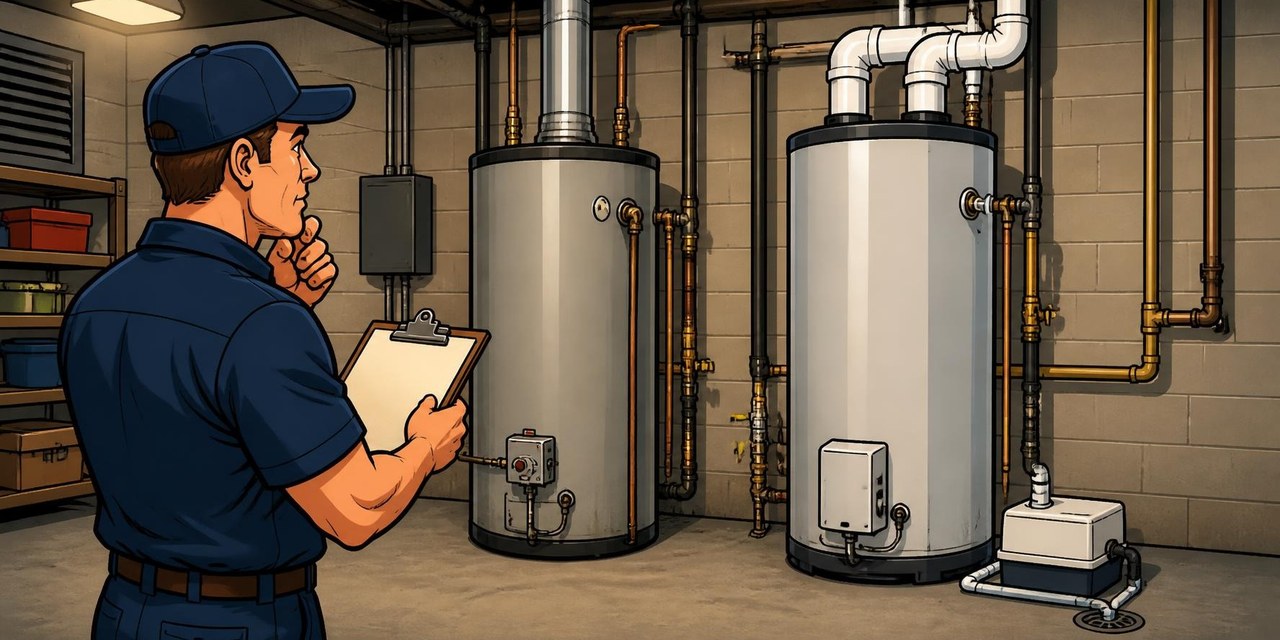
Quote a commercial gas water heater replacement as two separate tickets: a non-condensing unit, but only if your supplier can show you one in stock with a known build date, and a condensing unit with its venting, condensate parts, and extra crew hours priced line by line. Build each ticket from your loaded labor cost, your materials at cost, your overhead, and your margin, then date the quote and tie it to the specific unit you priced. The rest of this post walks through where each number comes from, a worked example with every line shown, and what to tell the customer about the rule.
What the rule actually changes for your quote
Legal status as of Oct 5, 2026. This section summarizes the federal documents named or linked below and isn't legal advice.
The DOE efficiency standard for commercial gas water heaters takes effect today. It applies to covered units manufactured on or after Oct 6, 2026 (10 CFR 431.110, as amended by the final rule published at 88 FR 69686 on Oct 6, 2023). For gas storage heaters, minimum thermal efficiency goes from 80% to 95%. For gas instantaneous heaters and hot water supply boilers, it goes from 80% to 96%. Residential-duty commercial gas storage units get higher UEF requirements too. Oil-fired and electric commercial water heaters did not change.
The size definitions in 10 CFR 431.102 decide whether a unit is covered. A commercial gas storage heater is rated above 75,000 Btu/h input. A commercial gas instantaneous heater is rated above 200,000 Btu/h. A gas storage unit at or under 105,000 Btu/h and 120 gallons can count as residential-duty commercial, which is still covered. Check the rating plate before you assume a small unit is outside the rule.
In practice, 95% thermal efficiency means condensing. The 2023 final rule records A.O. Smith supporting a standard "that will require the utilization of condensing technology." That is why the second ticket carries plastic venting, a condensate drain, and usually a neutralizer.
The rule regulates the manufacture date, not the install date. Bradford White's DOE FAQ (opened Oct 1, 2026) says units "manufactured prior to that date can still be sold and installed. Be sure to check your local building/plumbing codes." Do that last part. Your local code or utility program may set its own requirements.
The enforcement window
DOE's nonbinding enforcement policy, issued May 5, 2026, says it will not seek civil penalties for covered commercial gas water heaters manufactured from Oct 6, 2026 through Oct 5, 2027. The policy PDF (energy.gov, "2026 CWH Enforcement Policy, 5.04.2026 clarifications") covers gas storage and storage-type instantaneous heaters, gas instantaneous heaters and hot water supply boilers, and residential-duty commercial gas storage heaters. It also carries this disclaimer, verbatim:
"This policy does not create or remove any rights or duties and does not affect any other aspect of EPCA or DOE regulations, including the EPCA preemption provisions at 42 U.S.C. § 6297. This policy statement is not a final agency action, has no legally binding effect on persons or entities outside the federal government, and may be rescinded or modified in the Department's complete discretion."
So the rule date is Oct 6, 2026, fines are on hold for units built through Oct 5, 2027, and DOE can change or withdraw that hold whenever it wants. If a supplier page headlines Oct 2027, read that as the end of the penalty window. For pricing, the useful takeaway is narrower than the news: whether you can quote a non-condensing unit now depends on what manufacturers keep building and what your supply house has on the shelf.
Where the court case stands
The rule is also being fought over in court and at DOE:
- Apr 28, 2026: in a brief filed by the Solicitor General for DOE, the government agreed with the challengers that the rules rest on an "atextual and unsound" reading of "performance characteristics" and said DOE "is considering a new rulemaking."
- May 27, 2026: DOE closed comments on a petition from gas industry groups (AGA, APGA and NPGA) to move the compliance date to Jan 1, 2030 "at a minimum."
- Jun 8, 2026: the Supreme Court vacated the D.C. Circuit decision that had upheld the rule and sent the case back for further consideration in light of the Solicitor General's position.
- Jul 10, 2026: DOE asked the D.C. Circuit to hold the case in abeyance "pending administrative proceedings to revisit the challenged rules."
- Aug 6, 2026: Sen. Mike Lee introduced the Energy Efficiency Reform Act of 2026 (S. 5338), which would declare the rule "null and void." As of Oct 5, 2026 it has no cosponsors and no markup after a Sep 16 committee hearing.
- Sep 17, 2026: a D.C. Circuit panel granted DOE's motion and placed the challenges in abeyance "pending further order of the court," with DOE status reports due every 90 days starting Dec 16, 2026. The order does not vacate or remand the commercial water heater rule and says nothing about its Oct 6, 2026 compliance date.
For your quotes, that means the rule's future is unsettled, which is one more reason to quote both options and keep the quote tied to a specific unit.
Step 1: Find out what you can actually buy
Before you price anything, call the supply house. Manufacturers are making different choices. A.O. Smith's DOE page says it "will continue to manufacture, sell, and ship non-condensing commercial gas water heaters" during the enforcement period and that order cutoff dates have been removed. Bradford White's FAQ says it "will have limited non-condensing production" during the window and lists its current 55, 75, and 100 gallon power vent, atmospheric, and power direct vent commercial models as not meeting the new standard. On Oct 5, 2026, AF Supply listed A.O. Smith's atmospheric BTR-197 (100 gal, 199,000 Btu) at $9,495 and showed it out of stock.
- Ask for the exact model in stock. Write down model number, quantity, and the counter person's name. If they can't confirm stock, don't quote that unit as Option A.
- Ask for the manufacture date on the label. This is the date the rule cares about. If the counter can't read it to you, ask them to photograph the rating plate.
- Ask for a hold. A unit you haven't put a hold on is a unit someone else can buy before your customer signs. If the supplier won't hold it, say so in the quote (see Step 6).
- Get the price in writing. Your supplier quote or invoice is the source for the equipment line. If all you have is a website price, use it, but note the date you saw it, because these prices moved several times in 2026.
Don't assume non-condensing is always the cheap box. On Oct 5, 2026, Wholesale Water Heater listed Rheem's atmospheric G100-200 at $5,350 and its condensing GHE100SU-200 at $8,745, both 100 gal and 199,900 Btu. That same day, AF Supply's out-of-stock A.O. Smith atmospheric BTR-197 at $9,495 was listed higher than Wholesale Water Heater's Rheem condensing unit. Bradford White's condensing EF100T199E3N2 was listed at $12,552 by APEX Supply Co. Brand and seller swing the box price by thousands, so price the unit you can actually get.
One more edge case: if the job is in an area with ultra-low NOx rules, the box changes. Wholesale Water Heater listed the Rheem GNU100-200 ultra low NOx atmospheric unit, marketed as California, Utah, and Colorado compliant, at $6,525 on Oct 5, 2026.
Step 2: Build two tickets, not one ticket with a note
The two jobs share removal, setting, water and gas connections, and startup. They differ in venting, condensate handling, power, and hours. Write each ticket out completely so nothing hides in "misc." If you've already done this for A2L refrigerant jobs, it's the same two-option approach.
Option A, non-condensing (like-for-like)
- Heater, from the supplier quote
- Category I metal vent connector (B-vent) into the existing flue, from the supplier quote
- Gas connector, T&P discharge piping, fittings, from your parts list or last similar job ticket
- Any add-ons the site needs, such as a seismic gas shutoff or expansion tank
- Crew hours for removal, set, connections, and startup
Option B, condensing conversion
- Heater, from the supplier quote
- Sealed vent run in the material the manufacturer's installation manual allows (PVC, CPVC, or polypropylene), plus elbows and termination
- New wall or roof penetration and its sealing or flashing
- Condensate drain, condensate pump if there's no floor drain nearby, and a neutralizer kit
- A 120V outlet if one isn't within cord reach (electrician's quote if you don't do it in-house)
- Permit and inspection, if your jurisdiction requires them for the conversion
- Crew hours for everything in Option A, plus the vent run, penetration, drain, and pump
On the neutralizer, the 2023 DOE final rule notes that one "is not required in certain jurisdictions, though it is good design practice." Check your local code. If you leave it off, write that on the ticket so the customer knows it was a choice.
Step 3: Price the parts that only show up on a condensing job
These are the lines shops forget when they're used to dropping a tank onto an existing flue. Here's what the parts used in the worked example below cost at the listed suppliers on Oct 5, 2026. Your supplier invoice replaces every one of these.
| Part | Price (as listed on Oct 5, 2026) | Source |
|---|---|---|
| DuraVent 6BV36 Type B vent, 6" x 36" (Option A) | $41.27 each | Hardware World (backordered) |
| DuraVent PolyPro 4PPS-36C pipe, 4" x 36" (Option B) | $108.46 each | F.W. Webb |
| DuraVent PolyPro 4PPS-E90C 90° elbow, 4" (Option B) | $62.96 each | F.W. Webb |
| Axiom NC-2 Neutrapal condensate neutralizer kit | $193.75 each | Voomi Supply |
| Little Giant VCMA-20ULS condensate pump with safety switch | $73.44 each | Big Frog Supply |
| PVC Schedule 40 DWV pipe, 4" x 10' (only if the manual allows PVC) | $27.77 each | US Supply |
| Pacific Seismic 300/301 seismic gas shutoff valve (add-on) | $263.35 each | commercialwaterheatersales.com add-on list |
| Flexcon PH12 expansion tank, 4.8 gal (add-on) | $79 each | commercialwaterheatersales.com add-on list |
Some things the table can't give you. There's no sourced price here for gas line upsizing, the electrician's outlet, or roof flashing, so get those from your own supplier or sub quote. If you have no quote for a line yet, don't send the price out with a guess on it. Get the number or list that line as an exclusion.
For a sense of scale, Retrofit Plumbing (South Puget Sound, WA) publishes that a condensing venting upgrade "typically adds $500 to $1,500" to an installed price. That's their own customer-facing range for their market. Treat it as one shop's published number, not a benchmark for yours.
Step 4: Gather your own cost numbers
Every input to the price comes from a document in your office. Here's where to find each one and what to do when it's missing.
- Pull hours from job tickets on similar swaps. Retrofit Plumbing publishes 3 to 6 labor hours for a like-for-like commercial tank replacement. If you have no tickets, start from your best estimate and track actuals. For a condensing conversion, there is no reliable published figure for the added hours. Time your own first conversions, write the hours on the ticket by task (vent run, penetration, drain, pump), and use those numbers going forward. Don't borrow an hours figure from a cost-guide website.
- Take crew size from your schedule. A 100 gallon tank is a two-person lift for most shops.
- Work out your loaded labor rate, which is your cost for one hour of a tech's time. Your billing rate doesn't belong here. Start with the wage on your payroll report, then add payroll taxes, workers' comp, and benefits. BLS reports a median wage of $30.67/hr for plumbers, pipefitters, and steamfitters (occupation 47-2152, May 2025 data), and that's a wage only, before any burden. If you don't have your burden figured, the burdened labor rate guide walks through it.
- Take material cost from the supplier quote or invoice, at what you pay.
- Get your overhead % from the P&L by taking annual overhead (rent, office, insurance, trucks, tools, disposal) divided by annual direct cost. If you don't have a full year of books, use what you have and revisit it at year end.
- Read drive time from your dispatch or GPS history to that area, and fuel from your fuel card statement. Drive labor is paid for every person in the truck. More on that in the drive time post.
- Set your target net margin on price. It's a business decision you make once and apply to every job.
A worked example, line by line
This is an example. The equipment and parts prices are the Oct 5, 2026 listings above. The 6 hours is the top of Retrofit Plumbing's published 3 to 6 hour like-for-like range. Everything else is an assumed example input: say your loaded cost is $45/hr, you run a 2-person crew, the round trip is 1 hour (half an hour each way), fuel for the trip is $18, your overhead is 17%, and you want a 20% margin. Both options use the same 6 hours so the comparison isolates the box and the parts. A real conversion will usually take longer, which we'll get to.
The method, used for both options:
- Labor = hours x crew size x loaded labor rate
- Drive labor = drive hours x crew size x loaded labor rate
- Overhead = overhead % x (labor + drive labor + materials at cost)
- Total cost = labor + drive labor + fuel + materials at cost + overhead
- Price = total cost / (1 - margin)
Materials at cost
Option A: Rheem G100-200 at $5,350.00 (Wholesale Water Heater) + 2 x $41.27 DuraVent B-vent (Hardware World) = $5,350.00 + $82.54 = $5,432.54.
Option B: Rheem GHE100SU-200 at $8,745.00 (Wholesale Water Heater) + 4 x $108.46 PolyPro pipe ($433.84) + 2 x $62.96 PolyPro elbows ($125.92) (both F.W. Webb) + $193.75 Axiom NC-2 (Voomi Supply) + $73.44 Little Giant VCMA-20ULS (Big Frog Supply) = $9,571.95. The vent quantities (four 3-foot sections and two elbows for Option B, two B-vent sections for Option A) are assumed for the example.
| Line (example) | Option A, non-condensing | Option B, condensing |
|---|---|---|
| Labor: 6 hr x 2 x $45 | $540.00 | $540.00 |
| Drive labor: 1 hr x 2 x $45 | $90.00 | $90.00 |
| Fuel | $18.00 | $18.00 |
| Materials at cost | $5,432.54 | $9,571.95 |
| Overhead base: labor + drive labor + materials at cost | $540.00 + $90.00 + $5,432.54 = $6,062.54 | $540.00 + $90.00 + $9,571.95 = $10,201.95 |
| Overhead: 17% x base | $1,030.63 | $1,734.33 |
| Total cost: labor + drive labor + fuel + materials + overhead | $540.00 + $90.00 + $18.00 + $5,432.54 + $1,030.63 = $7,111.17 | $540.00 + $90.00 + $18.00 + $9,571.95 + $1,734.33 = $11,954.28 |
| Price: total cost / (1 - 0.20) | $7,111.17 / 0.80 = $8,888.96 | $11,954.28 / 0.80 = $14,942.85 |
| Profit: price - total cost | $8,888.96 - $7,111.17 = $1,777.79 | $14,942.85 - $11,954.28 = $2,988.57 |
Overhead rounds to the cent: 17% x $6,062.54 = $1,030.6318, shown as $1,030.63, and 17% x $10,201.95 = $1,734.3315, shown as $1,734.33. Option A's price is $8,888.9625 before rounding.
In this example, the material cost gap is $9,571.95 - $5,432.54 = $4,139.41, and the price gap is $14,942.85 - $8,888.96 = $6,053.89. The price gap is bigger than the parts gap because overhead and margin ride on the extra material cost. That's expected. More material dollars means more money tied up and more risk on the job, and the overhead and margin should cover it.
What each extra crew hour costs on Option B
Using the same example inputs, one more hour for a 2-person crew adds 1 x 2 x $45 = $90.00 of labor, plus 17% overhead on it ($15.30), for $105.30 of cost. At a 20% margin that's $105.30 / 0.80 = $131.625, or about $131.63 added to the price per crew hour. Three extra hours on a conversion you underestimated is 3 x $131.625 = $394.88 of price you didn't charge. That's why your own timed conversions matter more than any number in this post.
Entering the example in the calculator
You can run this in the job pricing calculator instead of doing it by hand, once per option. Here's where each example input goes:
| Calculator field | Option A (example) | Option B (example) |
|---|---|---|
| Estimated Hours | 6 | 6 |
| Number of Workers | 2 | 2 |
| Hourly Labor Rate (your loaded cost, not your billing rate) | $45 | $45 |
| Material Cost | $5,432.54 | $9,571.95 |
| Overhead % | 17% | 17% |
| Drive Time | 1 hr | 1 hr |
| Fuel / Travel Cost | $18 | $18 |
| Desired Profit Margin | 20% | 20% |
Fuel stays out of the overhead base, so overhead is figured on labor, drive labor, and materials only. Leave any field not listed at zero so the result lines up with the table above. Plumbing shops can start from the plumber pricing page or go straight to the calculator. For the general walkthrough of pricing any job this way, see how to price a contractor job.
Sanity-check the number before it goes out
Compare your result against published numbers, one at a time, and treat each as a rough guide rather than a target.
- Neveu Mechanical (MA and CT) publishes $7,000 to $15,000 for a single 75 to 100 gallon commercial gas or propane storage heater, and $10,000 to $22,000 for high-recovery units. Both example prices ($8,888.96 and $14,942.85) fall inside Neveu's single-unit range, with Option B near the top.
- Retrofit Plumbing (South Puget Sound, WA) publishes $3,000 to $8,000 for a small commercial install. Both example prices land above that range, which tells you their typical job is smaller or their market runs differently.
- Active Plumbing (Las Vegas, NV) publishes about $2,500 for a small salon up to $15,000 or more for a full-service restaurant, with permits and inspection at $150 to $600.
If your price sits far outside a range from a shop in a similar market, recheck your hours and your loaded rate first. Those are the inputs people get wrong most often.
DOE's own model is another cross-check. In the 2023 final rule (Table V.4, 2022 dollars, national average), the installed cost of an 80% thermal efficiency gas storage heater was $6,083 and a 95% unit was $7,593, a gap of $7,593 - $6,083 = $1,510. Shelf prices in these listings show a bigger equipment-only gap than that: $8,745 - $5,350 = $3,395 for the Rheem pair at Wholesale Water Heater, and $7,559 - $4,390 = $3,169 for the same Rheem pair on sale at commercialwaterheatersales.com, both as listed on Oct 5, 2026. That doesn't make either number wrong. It means a customer who read a DOE estimate may expect a smaller difference than the one on your quote, so be ready to show the box prices.
Step 5: Decide how the box earns its money
Enter materials at your cost. Your margin already earns profit on materials. If you also want a materials markup, use the optional Material Markup field: it adds profit on top of your margin, and the calculator shows your effective margin. On Option B, materials go in at $9,571.95. With markup at 0 and a 20% margin, the price is $14,942.85 and profit is $2,988.57, or 20.0% of the price. Most of that profit comes from the heater, because the heater is most of the cost.
Here is an example with a 15% material markup. $9,571.95 x 15% = $1,435.79. That amount is added to the margin price: $14,942.85 + $1,435.79 = $16,378.64. Total cost stays at $11,954.28, so profit is $16,378.64 - $11,954.28 = $4,424.36. Effective margin is $4,424.36 / $16,378.64 = 27.0%. The calculator does not gross the markup up by your margin and does not charge overhead on it. It is a straight add based on material cost.
A heavy box makes this a bigger dollar decision than it is on a small repair. Fifteen points on a $9,571.95 heater moves the price by more than $1,400, so check the effective margin against what your market will pay for this kind of job. Whatever you choose, use the same setting on both options so the A vs B comparison stays fair. The materials markup guide covers how to pick a percentage, and markup vs margin explains why the two numbers are not interchangeable.
Step 6: Tie the quote to the unit you priced
Equipment prices moved several times this year. Trade press (Supply House Times, Feb 27, 2026) reported A.O. Smith increases effective Feb 6, 2026 of 7% on standard commercial gas, 9% on single and multi-flue and all other commercial gas, and 3% on residential-duty commercial gas. A Bradford White letter dated Jan 29, 2026 announced 5% on commercial gas and electric tank units for orders on or after Mar 16, 2026. A Jun 15, 2026 article in The Hardwire News reported a 7% A.O. Smith water heater increase effective Jun 22, 2026, without saying whether commercial lines were included.
Your usual validity window still applies (the quote validity post covers how to set it). What this job adds is an availability clause on the specific unit, because a non-condensing unit you quoted may simply be gone when the customer calls back. Something like:
"Option A is priced on [model], manufacture date [date], held at [supplier] until [date]. Price is good for [X] days or while that unit is available, whichever comes first. If it is no longer available, we will re-quote using the closest available unit before any work starts."
Put the model number and manufacture date on the quote itself. If the supplier wouldn't hold the unit, say that plainly rather than leaving the customer to assume it's reserved.
What to tell the customer about the rule
Keep it short and stick to the documents. You can say:
- The DOE efficiency standard applies to covered commercial gas water heaters built on or after Oct 6, 2026.
- DOE has said it won't seek fines for covered units built through Oct 5, 2027, and that this policy is nonbinding and can be changed or withdrawn at any time.
- Units built before Oct 6, 2026 can still be sold and installed, subject to local codes.
- DOE has said it is considering a new rulemaking, and the case is paused while DOE reconsiders, so the rule could change later.
- Option A depends on a specific unit being available; Option B doesn't.
Don't promise them the rule is dead, delayed, or going away. If the rule changes after they sign, you'll both be better off having said only what the documents say. If they ask whether the condensing unit pays back, DOE's own analysis in the 2023 final rule (Table V.5) estimated that 17% of affected commercial gas storage buyers would see a net cost at the adopted level. So by DOE's estimate most buyers would not see a net cost, and some would. How much hot water the site uses has a lot to do with which group they're in.
Condensing units also bring new startup and callback risk if your crew is new to condensate and sealed venting. If you price a reserve for that, see the callback reserve post.
Mistakes that cost shops money on these jobs
- Shops put their billing rate in as the labor rate. If you enter what you charge per hour and then add margin, you're charging margin on margin. Use the loaded cost per hour from payroll.
- Some use the BLS wage as the loaded rate. The $30.67/hr figure is a median wage. Your cost per hour is higher once taxes, comp, and benefits are added.
- Drive time gets paid for one person when two ride to the job. Drive labor is drive hours x crew size x loaded rate.
- The Material Markup field gets used as a substitute for margin, and margin gets dropped to 0. Markup only adds profit on materials, so labor, drive time, fuel, and overhead go out at cost.
- Overhead gets figured on marked-up materials. It belongs on materials at cost. Running it on a marked-up number inflates the price for no reason.
- Condensing parts get buried in "misc." The customer can't compare options if the pump and neutralizer are hidden, and you'll forget them on the next quote.
- Option B gets priced with Option A's hours. The example does this on purpose to isolate parts. Your real quote shouldn't.
- The quote names a unit nobody has. Confirm stock and build date, and get a hold.
Run your own numbers
Put your real hours, loaded rate, and supplier prices into the job pricing calculator, once for each option, before the quote goes out.
This article is for educational purposes only and is not legal, financial, or tax advice. The legal summary is dated at the top of that section. Equipment and parts prices are as listed by the named suppliers on Oct 5, 2026 and change often. Worked-example inputs (loaded labor rate, crew size, drive time, fuel, overhead, margin, markup, and vent quantities) are assumptions for illustration. Check local codes and your own supplier pricing before quoting.